Free Tunisian Political Prisoners
1. Executive Summary
This report details the proceedings and outcomes of the Centre for Islamic Research - Africa (CIRA) Webinar addressing the severe democratic backsliding and the plight of political prisoners in Tunisia. The core focus centres on the arbitrary arrest and ongoing imprisonment of (Sheikh) Rached Ghannouchi (Speaker of Parliament and leader of the Ennahda party) alongside dozens of other political figures, activists and journalists. The discussion analysed the domestic manoeuvres of the current Tunisian leader Kais Saied, the role of external geopolitical actors in enabling his authoritarian regime, and structural parallels to historical liberation movements in South Africa. The event concluded with a definitive call for international solidarity, particularly from South African civil society and government bodies to demand the immediate release of Tunisian political prisoners and the restoration of democratic governance in Tunisia.
2. Background: Saied’s Coup and Consolidation of Power
The Mechanics of the Coup
Naeem Jinnah (Director: Afro-Middle East Centre) outlined the systematic sequence of Kais Saied’s power grab:
• July 25, 2021: Saied dismissed the Prime Minister, dissolved the government, suspended Parliament, and stripped MPs of parliamentary immunity.
• Institutional Dismantling: He arrested Speaker Rached Ghannouchi, disbanded independent judicial bodies, terminated scores of judges, and issued Decree 117. This decree allowed Saied to rule exclusively by executive order and exempted his decisions from judicial review.
• Constitutional Rewriting: Saied appointed a commission to draft a new constitution. When the commission presented its draft, Saied discarded it entirely and rewrote the text himself, officially centralising executive, legislative, and judicial powers within the presidency.
Political Context and Rise to Power
Yusra Ghannouchi (daughter of Sheikh Rached Ghannouchi) provided context on Saied's initial political ascent:
• The 2019 election: Saied, an unknown constitutional law professor, was elected largely via a protest vote. Perceived as untainted by the political establishment, he secured 600 000 votes in the first round and 3 million in the second. Revolutionary and reformist parties, including Ennahda, supported him as the "lesser of two evils" against a candidate viewed as corrupt and tied to the pre-revolution regime.
• Deliberate Destabilisation: From his inauguration, Saied actively disrupted parliamentary operations, refused to approve ministerial reshuffles, blocked legislation and exploited ambiguities in Tunisia’s mixed presidential parliamentary system. These actions were deliberate groundwork for the subsequent coup.
• Exploitation of COVID-19: During the pandemic, Saied reportedly dissuaded foreign governments and international partners from delivering financial aid and vaccines to Tunisia, artificially worsening the public health crisis to further discredit the democratic government.
3. External Geopolitical Facilitators
The report notes that Saied's authoritarian consolidation was actively enabled by external actors driven by migration management and counter-revolutionary agendas:
Gulf State Intervention • United Arab Emirates (UAE): The UAE has operated as a regional counter-revolutionary force since 2010, working to dismantle democratic transitions, particularly those involving Islamist-inclusive coalitions.
• Attempted Bribery: One week prior to the coup, the UAE alledgedly attempted to bribe then-President Moncef Marzouki with a substantial sum to ban and destroy the Ennahda party; Marzouki refused and exposed the bribe.
• Public Backing: Two weeks post-coup, UAE advisor Anwar Gargash publicly praised Saied’s actions as a "positive agenda". In October 2024, the UAE formally congratulated Saied on a highly controlled re-election where Saied claimed over 90 percent of the vote.
• Regional Support: Saudi Arabia, Egypt and Bahrain similarly backed Saied's regime, viewing democratic governance and Islamist participation as existential threats to their own political models.
European Union Complicity
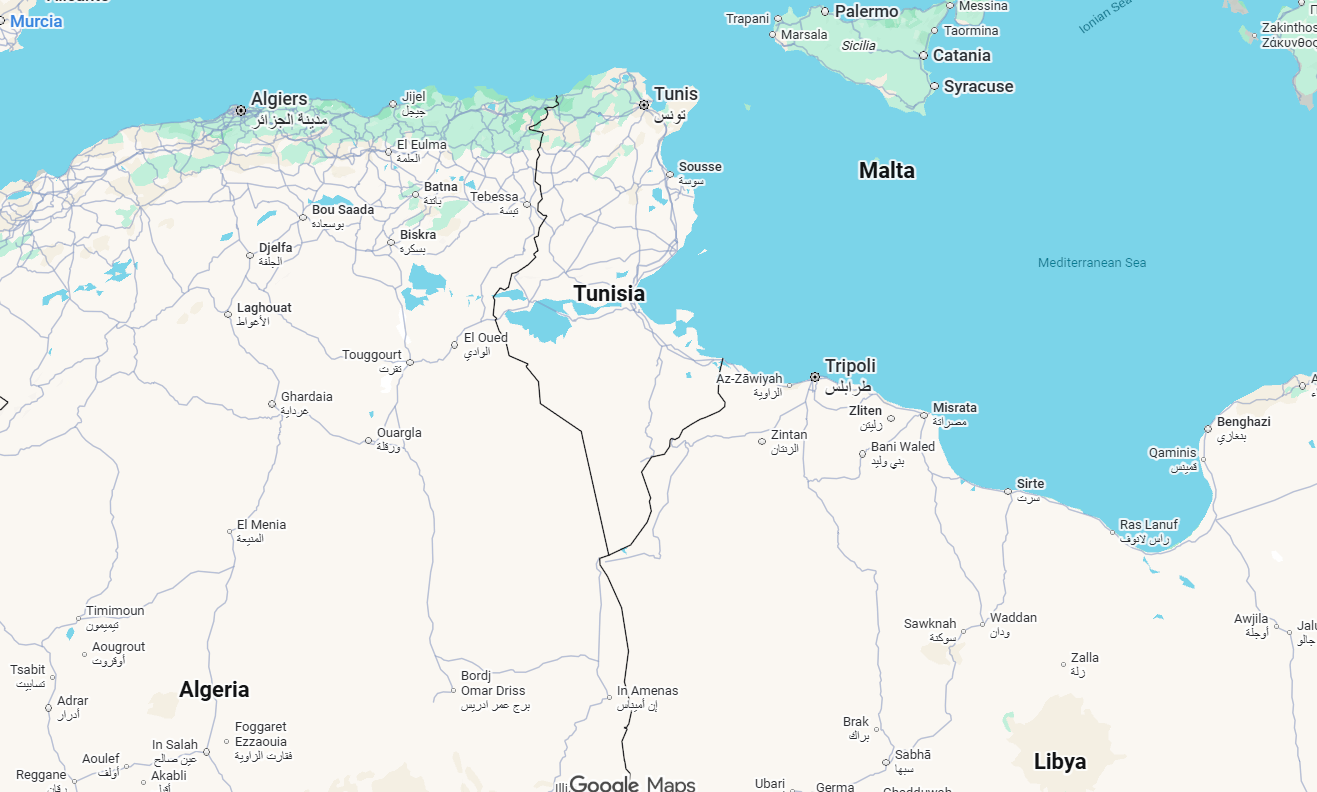
• The Migration Agreement: On July 16, 2021, nine days before the coup, the European Union signed a Memorandum of Understanding (MOU) with Tunisia. The EU pledged direct economic support in exchange for strict Tunisian border enforcement to limit Mediterranean migration, effectively granting de facto external legitimacy to Saied just as he prepared to seize total control.
• Broader Patterns: Previously, EU funding was directed to Sudan's Rapid Support Forces (RSF, formerly the Janjaweed) to block sub-Saharan migration, characterising it as a broader European policy that externalises borders and fuels systemic xenophobia across the African continent.
4. Repression and Political Prisoners
Scale of the Crackdown
The number of political detainees escalates near daily, a trajectory highlighted by the Tunisian Justice Minister's public announcement regarding the construction of new prison facilities. The regime has also moved against independent civil society, shutting down local branches of Lawyers Without Borders, the Tunisian Organisation of Young Doctors, and the Tunisian Human Rights League (the oldest human rights league in Africa and a co-recipient of the 2015 Nobel Peace Prize).
Profile of Prominent Detainees
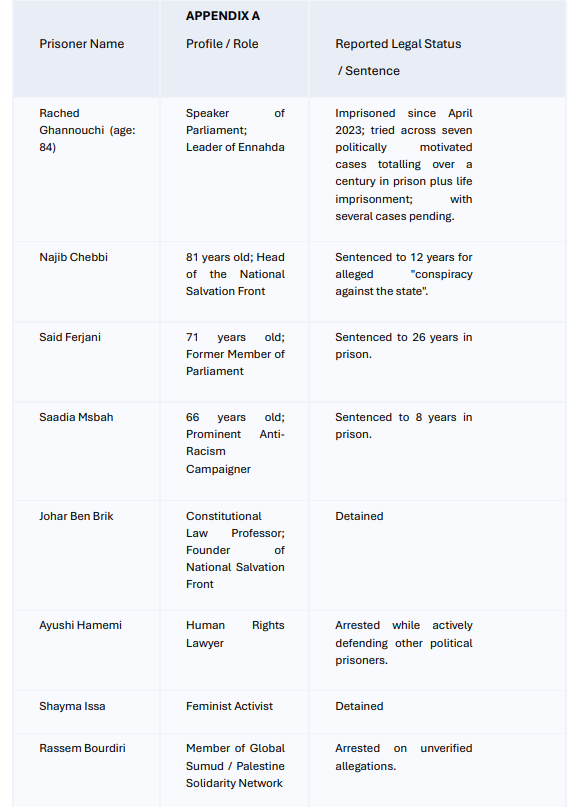
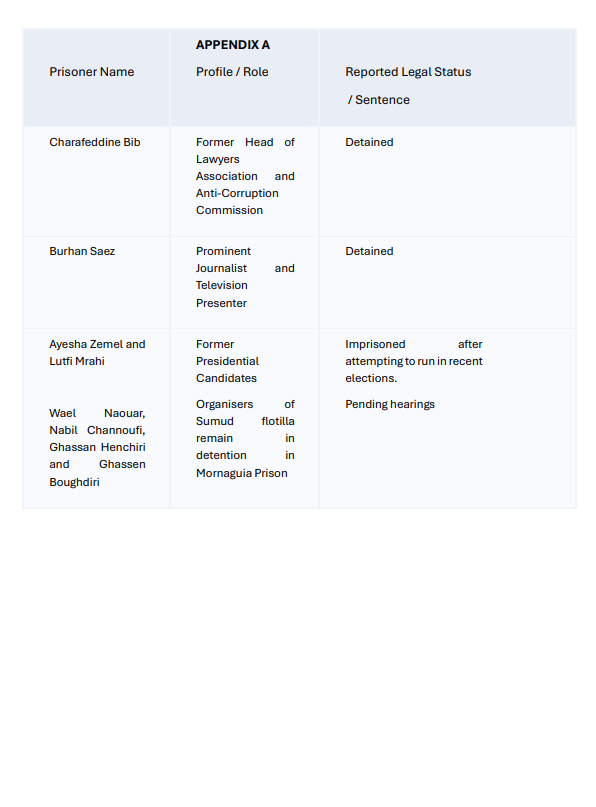
The targeted individuals span a broad ideological spectrum, illustrating that the repression targets democratic dissent generally, rather than a single faction (See Appendix A at the end of the Report).
Case Focus: Sheikh Rached Ghannouchi
Sheikh Rached Ghannouchi has been detained since April 2023, adding to his history as a political prisoner under previous Tunisian dictatorships. In February 2026, the UN Working Group on Arbitrary Detention concluded that his arrest violated multiple facets of international human rights law and demanded his release.
Ghannouchi officially boycotts all judicial proceedings, refusing to recognise the legitimacy of a judiciary controlled by the Executive following Saied's unilateral dismissal of 57 judges and the dissolution of the Supreme Judicial Council. Trials are held strictly behind closed doors without media presence; defendants are forced to appear remotely; and prosecution files rely almost entirely on anonymous witness testimonies that defence counsels are barred from cross-examining.
In a letter written from prison marking his third year of detention, Sheikh Ghannouchi stated: "Dictatorship and autocratic rule remain a disease, not a cure... The future must be built on partnership, not on excluding dissenting opinions. This country is not anyone's inheritance; it belongs to the people."
5. Perspectives and Strategic Frameworks
Tunisia's Historical Trajectory
Tunisia was long celebrated as the Arab Spring's sole success story because it was the only nation from the 2010–2011 uprisings to establish a stable, peaceful democratic transition characterised by regular elections and genuine rotations of power. In contrast, Egypt suffered a military coup in 2014, while Libya, Syria and Yemen collapsed into civil wars.
Following the 2011 revolution, Ennahda won approximately 40 percent of the Constituent Assembly vote and chose to form a coalition government with two leftist parties holding 15 percent and 10 percent respectively. By 2014, when Ennahda placed second to a party primarily composed of old-regime figures who pledged alignment with the new constitution, Ennahda entered a coalition again to preserve national stability. Throughout this decade, Ennahda and Sheikh Ghannouchi consistently prioritised multi-party governance and directly facilitated the national dialogue that won the 2015 Nobel Peace Prize.
Human Rights Jurisdiction Backsliding
In March 2025, Tunisia withdrew its Declaration under Article 34 of the African Court on Human and Peoples' Rights Founding Protocol (taking effect in March 2026). This structural shift blocks individuals and NGOs from filing direct cases against the state. Crucially, this withdrawal occurred while Tunisia accounted for 7 percent of all active court matters (24 applications), primarily concerning fair trial and democratic rights.
Lessons from South Africa
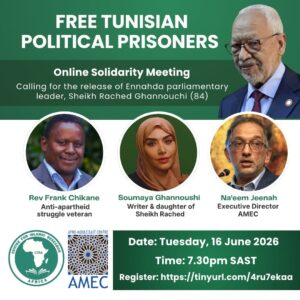
Reverend Frank Chikane drew direct comparisons to South Africa's anti-apartheid struggle, noting that any regime dependent on arbitrary detention and systemic suppression lacks popular legitimacy. He critiqued Western human rights rhetoric, stating that Western powers frequently protect liberties only for themselves and their geopolitical allies, citing international policy on Palestine as an example of this double standard.
Reflecting on the anniversary of 16 June 1976 Soweto Students’ Uprising in South Africa, Reverend Chikane warned that when progressive forces miscalculate or make critical governing errors, they can inadvertently create a vacuum filled by dictators, a dynamic visible in Tunisia. He urged the contemporary Anti-Apartheid Movement to spearhead a global coalition against autocracy and political imprisonment.
Regional and African Union Response
The African Union (AU) has failed to adopt an official stance against Saied’s coup or the dissolution of Tunisia's democratic infrastructure, despite explicit mandates within the AU Constitutive Act outlawing unconstitutional changes of government.
While the AU criticized Saied’s derogatory rhetoric regarding sub-Saharan migrants, which triggered a rise in local xenophobic violence, it has not condemned the coup itself.
In September 2022, the African Court on Human and Peoples' Rights ruled that Saied's executive decrees were unconstitutional and ordered their repeal alongside a restoration of democratic institutions within two years. The compliance deadline passed in September 2024, without action from the Tunisian presidency. Families of political prisoners have filed subsequent cases with the Court; while provisional measures have been granted in their favour, final merits decisions remain pending.
6. Analytical Takeaway
Tunisia’s democratic regression is not an inevitable cultural or regional outcome. It is the direct consequence of a deliberate authoritarian project engineered by an individual, who exploited public frustration, structural constitutional vulnerabilities, backing from selected Gulf states, and an external migration policy managed by the European Union. South African civil society, human rights networks and government bodies possess a distinct historical responsibility to challenge this regression through co-ordinated international pressure and solidarity with Tunisian political prisoners.
7. Proposed Solidarity Actions
a. Collective endorsement of demands by a wider range of South African civil society organisations for the immediate, unconditional release of all Tunisian political prisoners and an immediate halt to politically motivated prosecutions.
b. Expansion of the current solidarity coalition beyond Muslim community organisations to encompass a broader spectrum of South African civil society.
c. Formal engagement with the South African government to initiate diplomatic interventions with Tunisian authorities.
d. Lobby the South African government to formally summon the Tunisian ambassador to raise official government concerns regarding political prisoners and democratic backsliding.
e. Apply direct pressure on the Tunisian Embassy in South Africa to engage with civil society; publicly highlight any refusal to engage as a pressure point.
f. Broaden the joint statement signed by South African civil society organisations to integrate secular, labour and human rights forces.
g. Partner with broadcast, print, and radio media platforms to build public awareness regarding the situation in Tunisia.
h. Co-ordinate directly with international bodies, including Amnesty International and Human Rights Watch, to scale up the solidarity campaign.
i. Continue highlighting the full diversity of the political prisoner cohort to counter state narratives and emphasise the baseline illegality of the charges.
j. Utilise the Anti-Apartheid Movement framework to construct an international network linking organisations that oppose dictatorship and arbitrary imprisonment across Africa and globally.
k. Lobby the African Union to formally enforce its Constitutive Act regarding the unconstitutional changes of government in Tunisia.
l. Establish a permanent working group for ongoing solidarity operations.
m. Await the final decision on the merits from the African Court on Human and Peoples' Rights regarding the case brought forward by the Ghannouchi family.